

Wood Plastic Decking
Your Professional Wood Plastic Decking Supplier
Our goal is to become your true partner in the field of artificial grass tiles in China. Watsun is a leading professional supplier of composite products. Our experienced team has extensive knowledge and practical experience of composite materials. We have a skilled engineering team dedicated to refining every stage, from product development and process improvement to production oversight, ensuring every product delivered meets rigorous quality and performance standards. The price is competitive and the product is quality-assured, which is a good choice for your long-term cooperation.


Why Choose Us
Our Certificates: Our products all meet the requirements, we have CE certification, ISO certification, FSC certification and SGS certification.
Product Market: Our products are very popular in the market and are exported to Australia, America, Europe and other parts of the world.
Our Services: In the pre-sales stage, our team of experts will recommend the most suitable products according to the needs of customers and provide detailed technical consultation. During the sales period, we ensure timely delivery and provide installation guidance. For after-sales, we provide long-term technical support, warranty services and spare parts to help customers maximize the use of products and get reliable maintenance during use.
Advantages of Wood Plastic Decking
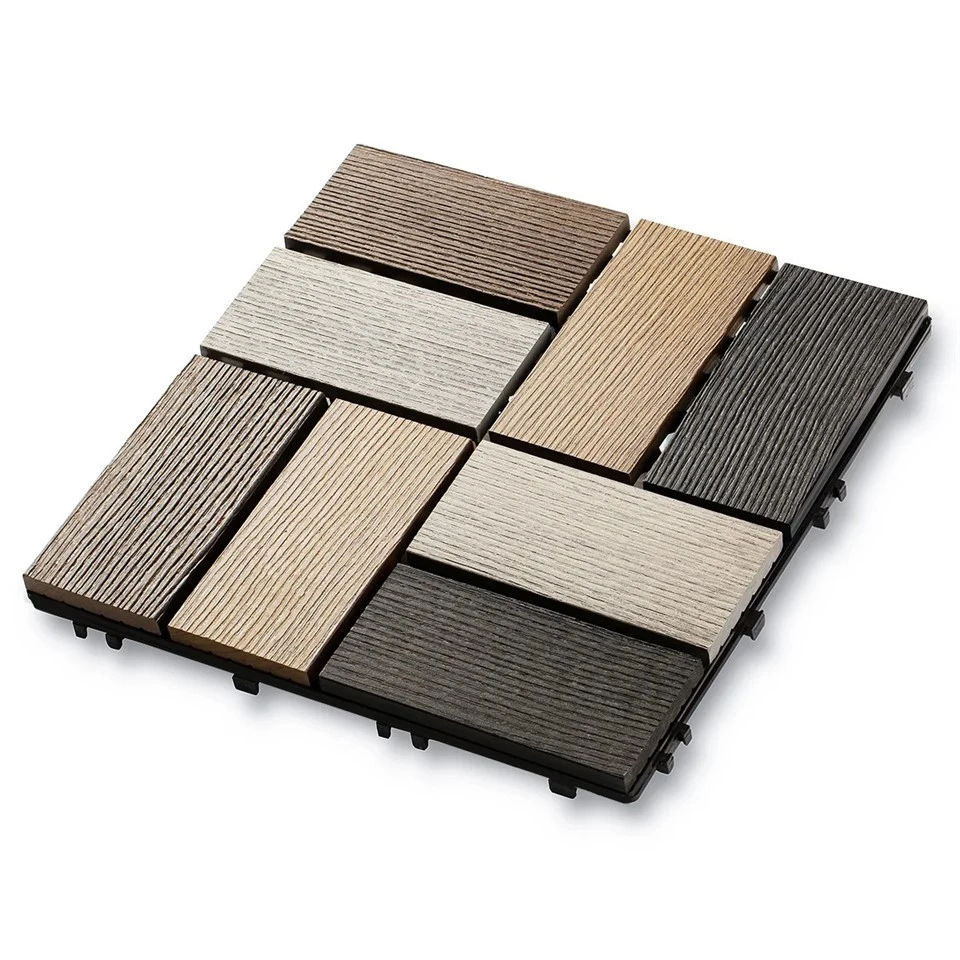
Wood plastic decking comes in a variety of colors, textures, and finishes, making it highly adaptable to different design preferences. It can closely mimic the natural beauty of wood or offer more contemporary options, providing designers with creative freedom.
Made from a blend of recycled wood fibers and plastics, wood plastic decking is an environmentally responsible choice. It contributes to reduced deforestation and plastic waste, aligning with sustainable building practices.
Wood plastic decking is designed to be slip-resistant and does not splinter, making balconies safer, especially in households with children or pets. Its insulating properties also mean it’s more comfortable underfoot than traditional decking materials.
Unlike traditional wood, wpc is not susceptible to pest infestations, ensuring the balcony remains pristine and undamaged over time.
The installation of wood plastic decking and deck tiles is straightforward, often featuring interlocking systems that reduce installation time. Moreover, the material allows for various customization options, enabling unique balcony designs that reflect individual styles.
Product Parameters of Wood Plastic Decking
|
Color Family |
Gray |
Color/Finish |
Classic Gray |
|
Edge Type |
Square |
Fastener recommendation |
TOPLoc |
|
Features |
Prefinished, UV Protected, Water Resistant |
Material |
Composite |
Types of Wood Plastic Decking
Plastic wood deck boards
The benefits are numerous compared to traditional wood decking. A diverse range of composite decking color options enables you to effortlessly design a personalized outdoor oasis. They come in a variety of hues, eliminating the need for exterior staining and simplifying the maintenance process. Engineered for long-lasting performance, composite decking resists rot and warping, ensuring your deck maintains its stunning beauty with minimal upkeep.
Wood plastic composite boards
Wood plastic composite (wpc) is a new type of composite material that is made up of natural plant fibers, such as wood, bamboo and hemp, and thermoplastic, such as polyethylene (pe), polypropylene (pp) polyvinyl chloride (pvc), and so on.
Plastic decking board
Plastic deck boards are typically referred to as either composite decking or pvc decking. These terms are often used interchangeably in the industry, though they have slight differences.
Application of Wood Plastic Decking
Decks
Wood plastic decking is a popular choice for building decks around homes, offering a durable and low-maintenance alternative to traditional wood decking.
Walkways & patios
Wood plastic decking can be used to create walkways and patios, providing a durable and aesthetically pleasing surface.
Cladding & siding
Wpc can be used for cladding and siding, offering a weather-resistant and visually appealing exterior finish.
Railings & steps
Wpc can be used to create railings and steps for decks and porches, providing a durable and safe solution.
Docks & marinas
Wood plastic decking is ideal for docks and marinas, offering resistance to water and marine environments.
Public spaces
Wpc can be used in public spaces like parks, plazas, and walkways, providing a durable and attractive surface.
Restaurants & hotels
Wood plastic decking can be used in outdoor areas of restaurants and hotels, offering a stylish and low-maintenance option.
Sports venues
Wood plastic decking can be used in sports venues, providing a durable and safe surface for players and spectators.
Production Process of Wood Plastic Decking
WPCs are produced by thoroughly mixing ground wood particles and heated thermoplastic resin. The most common method of production is to extrude the material into the desired shape, though injection molding is also used. WPCs may be produced from either virgin or recycled thermoplastics including high-density polyethylene (HDPE), low-density polyethylene (LDPE), polyvinyl chloride (PVC), polypropylene (PP), acrylonitrile butadiene styrene (ABS), polystyrene (PS), and polylactic acid (PLA).
PE-based WPCs are the most common. Additives such as colorants, coupling agents, UV stabilizers, blowing agents, foaming agents, and lubricants help tailor the end product to the target area of application. Extruded WPCs are formed into both solid and hollow profiles. A large variety of injection molded parts are also produced, from automotive door panels to cell phone covers.
In some manufacturing facilities, the constituents are combined and processed in a pelletizing extruder, which produces pellets of the new material. The pellets are then re-melted and formed into the final shape. Other manufacturers complete the finished part in a single step of mixing and extrusion.
Customizable Wood Plastic Decking
Color and texture
Wood plastic decking is available in a wide array of colors, from natural wood tones to more modern shades, allowing for a diverse range of styles. Many manufacturers offer color-blending technology for realistic wood grain patterns and subtle multi-tonal effects.
Custom design
Some companies specialize in custom-designed decks, offering personalized renderings and layouts to fit specific needs and preferences.
Material options
Wood plastic decking comes in various forms, including capped and uncapped boards, each offering unique benefits in terms of durability, aesthetics, and maintenance.
Low maintenance
Wood plastic decking requires minimal upkeep compared to traditional wood decking, reducing the need for staining, painting, or sealing.
Durability
Wood plastic decking is engineered to resist rot, warping, and fading, ensuring a long-lasting and beautiful deck.
Cost-effective
While the initial cost May be higher than traditional wood, the lower maintenance and longer lifespan can make wpc a more cost-effective option in the long run.
Packing and Shipping of Wood Plastic Decking
|
Packing |
Wooden box |
|
Shipping |
Shipped by road, sea, rail |
FAQ
As one of the most professional wood plastic decking manufacturers and suppliers, we're featured by quality products and good price. Please rest assured to wholesale cheap wood plastic decking from our factory.
decking, Plastic Wood Deck Boards, wood plastic decking