

Composite Decking
Your Professional Composite Decking Supplier
Our goal is to become your true partner in the field of artificial grass tiles in China. Watsun is a leading professional supplier of composite products. Our experienced team has extensive knowledge and practical experience of composite materials. We have a skilled engineering team dedicated to refining every stage, from product development and process improvement to production oversight, ensuring every product delivered meets rigorous quality and performance standards. The price is competitive and the product is quality-assured, which is a good choice for your long-term cooperation.


Why Choose Us
Our Certificates: Our products all meet the requirements, we have CE certification, ISO certification, FSC certification and SGS certification.
Product Market: Our products are very popular in the market and are exported to Australia, America, Europe and other parts of the world.
Our Services: In the pre-sales stage, our team of experts will recommend the most suitable products according to the needs of customers and provide detailed technical consultation. During the sales period, we ensure timely delivery and provide installation guidance. For after-sales, we provide long-term technical support, warranty services and spare parts to help customers maximize the use of products and get reliable maintenance during use.
Advantages of Composite Decking
One of the greatest benefits of composite decking is its minimal maintenance. Traditional wood decks need extensive upkeep every 1 to 3 years and will need to be replaced every 10 to 15 years — a labor intensive and costly process. Wood decks also require regular power-washing and staining to keep their color.
When you shop for materials to build your deck, you’ll find that you have options for both wood and composite decking.
A concern you May have with using composite deck boards is the possibility of an inorganic, fake look or feel. Designed with realistic grain patterns, authentic color blending, and nature-inspired hues, composite decking innovates beyond the plastic-y-looking deck material found in competing brands.
Wood decks require a lot of maintenance that can not only exhaust your energy, but also your finances. In as little as six months, the original luster of wood boards can fade due to exposure to UV rays, precipitation, and other weathering agents.
The long-term benefits of composite decking often outweigh the cheaper cost of a traditional wood deck. Initially, the cost of a composite deck can be higher than a wood deck.
Product Parameters of Composite Decking.
|
Product name |
Composite decking |
|
Material |
Wood plastic composite |
|
Colour |
Three colours (Red Brown, Dark Brown, Natural) |
|
Product size |
(L×W×H) 300mm×75mm×22mm/pcs |
Types of Composite Decking
Hollow composite decking
Hollow composite decking, like our natura grooved composite decking, is lighter and often more cost-effective than solid decking. It's designed with hollow channels that reduce weight and material usage.


Solid composite decking
Solid composite decking resembles traditional wood. Made from a blend of wood fibres and plastics, it's heavier and denser, offering strength and stability, but making it less versatile.
Uncapped composite decking
Uncapped composite decking is the original form of composite materials. It's durable and offers the natural look of wood, but it requires more maintenance to protect against mould, mildew, and fading. It's a budget-friendly option for those who don't mind a bit of upkeep.

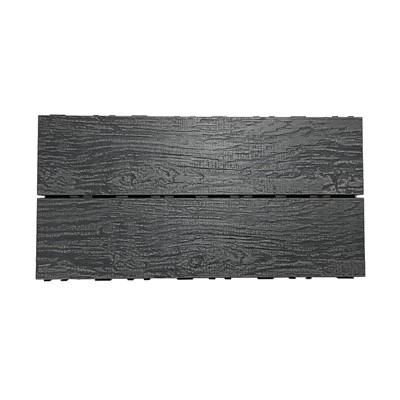
Capped composite decking
Capped composite decking features a protective polymer shell that guards against fading, staining, and scratching. It's more resistant to the elements and requires less maintenance than uncapped decking.
Grooved composite decking
Grooved composite decking boards have grooves along the sides for hidden fasteners. This creates a sleek, nail-free look for your deck. It's perfect for a modern, clean aesthetic but requires compatible fastening systems.


Ungrooved composite decking
Ungrooved composite decking, such as woodgrain composite decking, is designed with a smooth edge and is typically fastened with nails or screws. This traditional installation method is straightforward but can leave visible screws on the deck surface, affecting the overall look.
Application of Composite Decking
Building A Backyard Deck, A Porch, Or A Floor: As we said above, the most common use of composite decking, as its name implies, is to build a deck for a person’s home. This can be a deck located in the backyard or in the front.
Pathways Through The Yard: Another way composite boarding can be used is to form a pathway through a yard. Some people don’t like walking on grass, particularly when it is wet. Elderly people, for example, might want to avoid wet grass or tall grass to keep from tripping.
A Swimming Pool Deck: Not too dissimilar from a basic porch deck would be a swimming pool deck. Composite decking is an excellent material for such a structure. As we’ve said, it is highly resistant to mold, rot, and staining.
A Trash Bin Enclosure: Another excellent use for composite decking is to build a trash bin enclosure. Again, the durability of the material against the elements makes them the ideal material to keep something as inherently dingy as a collection of trash bins neat and tidy.
Cladding Or Siding On A House Or Other Structure: Although they are not normally good for structural uses (like support beams and such), composite decking boards can be used for siding or cladding. This can make any structure look neat, clean, and classy.
Benches For One’s Backyard And Gardens: Composite decking boards can be used to build beautiful benches for a backyard or a garden. The material rivals natural wood in beauty and it has the added bonuses of being warp-resistant and unlikely to break off in splinters. Two big pluses.
Backyard DIY Projects: Some older varieties of composite decking lack the usual capping and covering that helps protect the material from the elements. As a result, this older material isn’t as resistant to molding, fading, and staining as modern composite decking.
Production Process of Composite Decking
Extrusion or moulded
This is the main method by which composite boards are made. Materials are combined and then either moulded into the desired shape or fed into an extrusion machine to create a board which is then cut to size.
Co-extrusion
Co-extrusion is a method by which the surface of a deck board is covered with a durable membrane. This membrane usually contains UV inhibitors, colourants, and antioxidants to conserve the materials and make the board last longer.
Post-Processing of Composite Decking
|
Surface treatment |
Anti-slip texture, wood grain effect, sandblasting, UV protection coating, etc. |
|
Coefficient of thermal expansion |
Low thermal expansion coefficient, suitable for environments with various temperature changes |
|
Maintenance |
Easy to clean, no need to paint, clean surface stains regularly, avoid washing the floor with water |
Packing and Shipping of Composite Decking
|
Packing |
Wooden box |
|
Shipping |
Shipped by road, sea, rail |
FAQ
As one of the most professional composite decking manufacturers and suppliers, we're featured by quality products and good price. Please rest assured to wholesale cheap composite decking from our factory.
composite deck boards price, aluminum decking boards, Plastic Composite Decking